|
| |
An open letter to
Debora Iyall:
Dear Debora,
Thanks for writing the immortal lyrics to A Girl In Trouble (Is A Temporary
Thing)
This Thank-You is long overdue. I should have written it back in 1984, but
your (Romeo Void's) lawyer was screwing my husband at the time and I guess I
forgot to mentally separate the two issues. That was a long time ago and I had
the pleasure of telling the lawyer involved when she telephoned my home that she
was just a "voice on the phone" to me. I also dispatched that husband shortly
thereafter, so if your lawyer is reading this, No Hard Feelings.
Back to the real point, Debora you are a true artist and I have to tell you
that I think your lyrics to A Girl In Trouble are truly Brilliant. They've
helped me keep my wig on straight on more than one occasion, during more than
one difficult patch. Now 28 years later, I caught myself quoting two lines
from that song to my 34 year old daughter. As apropos today as in 1984.
A Girl in Trouble (is a temporary thing) Iyall/Woods/Zincavage
She's got a face that shows that she knows she's heard every line
Tenderly she talks on the phone
There's a way to walk that says, "Stay away"
And a time to go 'round the long way
A Girl in Trouble is a temporary thing,
temporary temporary, temporary, temporary
A Girl in Trouble is a temporary thing, temporary temporary, temporary,
temporary
There's a time when every girl learns to use her head
Tears will be saved 'til they're better spent
There's not time for her to be afraid, so instead
She takes care of business keeps a cool head
A Girl in Trouble is a temporary thing, temporary temporary, temporary,
temporary
A Girl in Trouble is a temporary thing, temporary temporary, temporary,
temporary
She's on the mend and knows that she's earned the scars and the lines
By and by - one step at a time
Her love can dazzle and delight - she transcends
And has more riches than she can spend
A Girl in Trouble is a temporary thing, temporary temporary, temporary,
temporary
A Girl in Trouble is a temporary thing, temporary temporary, temporary,
temporary
A Girl in Trouble is a temporary thing
Credit where Credit is due:
http://www.deboraiyall.com/blog.html/a_girl_in_trouble_is_a_temporary_thing/
Thanks for your Insights Deborah,
Dwayna Wisdom
Women's Ink: Brush With Greatness:
From the New York Times Magazine, William Safire column "On Language"
February 6, 2000
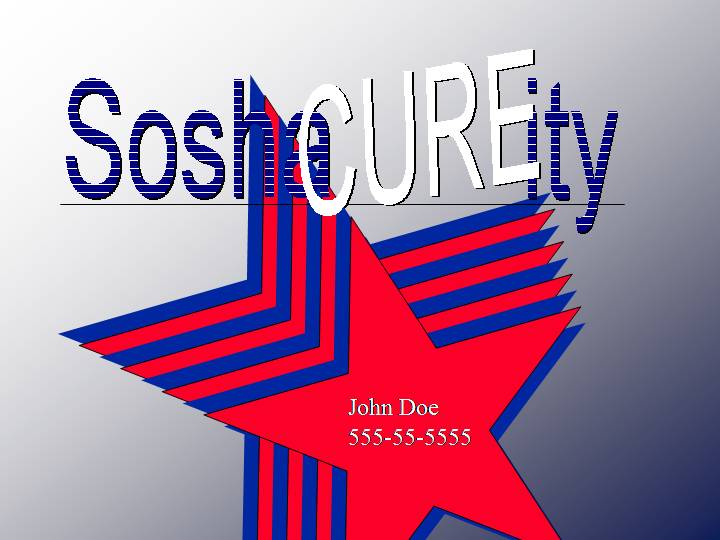
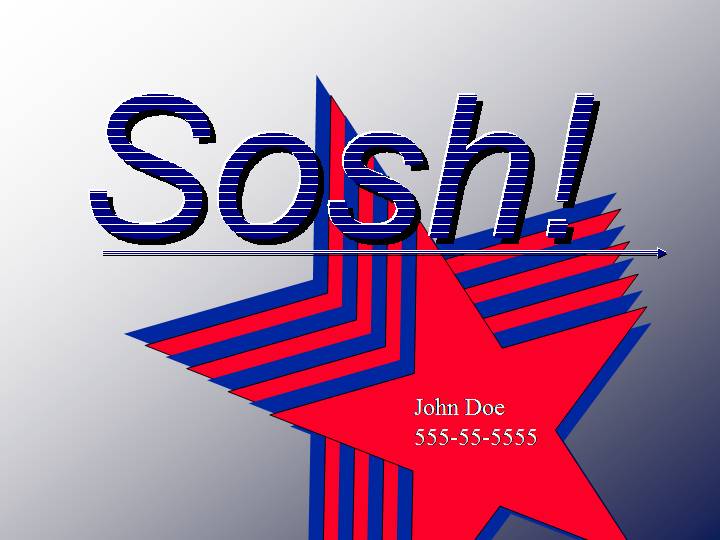
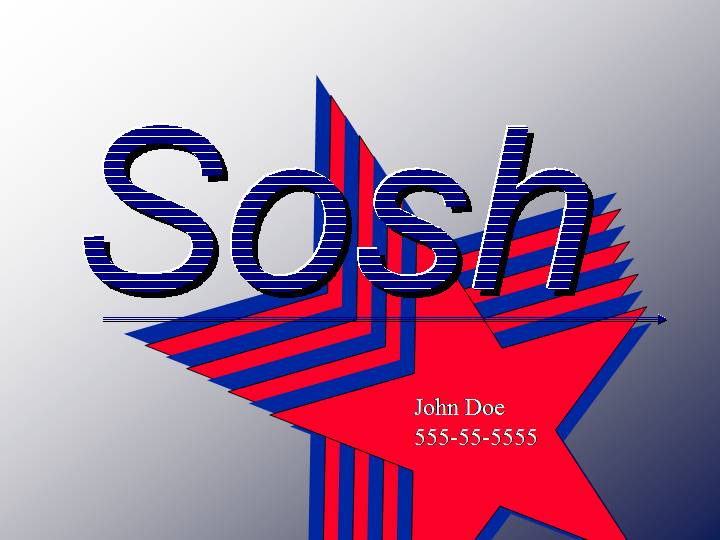
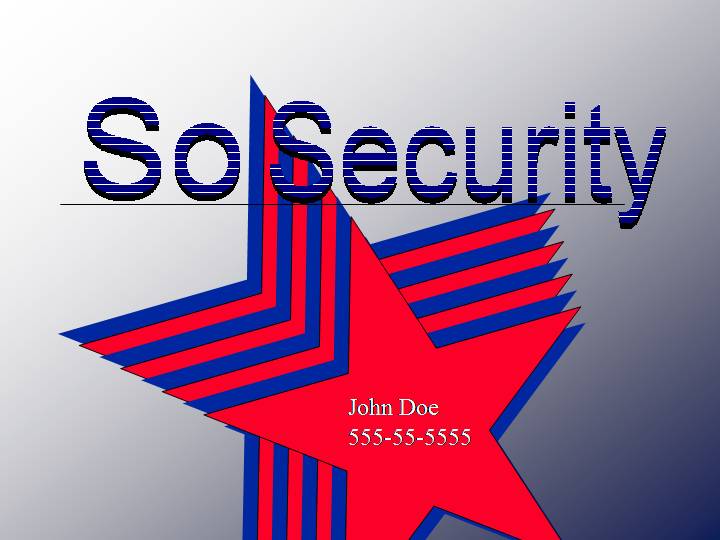
We wrote to Bill Safire suggesting some new Social Security Card Designs
based on the common mispronunciations of the term Social Security. He was
kind enough to give us a mention in his column.
...A
special target for the squirrels of squeeze has been Social
Security. This generation, promised six full syllables with no
cutbacks, was willing to accept "Soshasecurity." But what of the
candidates who promise the salvation of "Sosh-security" or preserving
untouched the indexed benefits of "Sosa-CURE-ity"?
Dwayna M. Wisdom of Union City, N.J., notes other variations from "SoSecurity"
to "Soshacurity."
ON
LANGUAGE BY WILLIAM SAFIRE

Cramming
it together as the wave of the Future.
 ush
Limbaugh, the radio philosopher, was appalled. Thousands of his
listeners were sending in messages protesting the increased number of
commercials on his program. Because he was talking the same amount of
time every day, and the show ran the same three hours, how could this
be? ush
Limbaugh, the radio philosopher, was appalled. Thousands of his
listeners were sending in messages protesting the increased number of
commercials on his program. Because he was talking the same amount of
time every day, and the show ran the same three hours, how could this
be?
Then a surreptitious form of editing was revealed to him. "A new kind
of digital technology," wrote Alex Kuczynski in The New York Times, "was
literally snipping out the silent pockets between words, shortening the
pauses and generally speeding up the pace of Mr. Limbaugh's speech." The
irate commentator stormed, "I think it is potential doom for the radio
industry." Since then, he tells me: "I have amended that. They will
reduce the pauses judiciously, no more than a minute and a half per
hour. I want to see if the nuances are affected -- after all, a pause
can be pregnant."
Decades ago I did something similar to Humphrey Bogart. He had a
habit, as do many of us, of punctuating his ad-lib phrases with "uh."
(This has since been replaced with "I mean" and "y'know," which serve
the same function of demonstrating a presence while not saying
anything.) When Bogie had a couple of drinks, the uh's came thick and
fast. In the 50's, after taping an interview with him for the Armed
Forces Network, I did him a favor and laboriously snipped all those
stammering self-interruptions out of the tape. When our talk was
broadcast, he was surprised at how articulate he sounded.
In most cases, I would do the same today as a courtesy to interviewee
and listener. I'll even clean up a grammatical error when taking notes
for a written interview, thereby preserving a source and avoiding
[sic-sic-sic] wiseguyism. But secret snipping for commercial gain is
another kettle of fishiness. Not only is it sneaky, but the silent
squeeze also weakens discourse by removing dramatic pauses.
A related danger is not a result of nefarious squeezing by
money-grubbing timesavers, but of the hurried laziness of speakers.
Let's not be stiffs about this: in pronunciation, the English language
has always tended toward contraction. Old-timers cannot recall ever
having heard business, colonel or Wednesday
pronounced with three syllables. Chocolate, which geezers recall
as CHOCK-a-lit, has become CHAW-klit; its central syllable melted away
in our mouths. In a 1949 article in The New Yorker (now The Nyawka),
John Davenport commented on "Slurvian," the language of what linguists
call syncope (SING-kuh-pee). In this laid-back lingo, syrup becomes
surp, Americans Merkins, and "no, Ma'am" gnome. His
forn, for "foreign," was picked up by the Central Intelligence
Agency, and now "no foreign distribution" is stamped NOFORN.
In our time, such speeding up must not go unremarked. In today's
compulsive compression, other majestic and sonorous words are losing
their central syllables. In "The Big Book of Beastly Mispronunciations"
(Houghton Mifflin, 1999, $15), Charles Harrington Elster argues that
"syncopated pronunciations tend to improve the fluidity of speech" and
cites VEJ-tuh-bul for vegetable, FAM-lee for family and
DY-pur for diaper. (Only babies say "change my DI-a-per.")
This has not taken place in a vacuum. (That word was once pronounced
VAK-u-um, but our natures abhorred it, and it's now VAK-yoom.) However,
Elster still cites as objectionable to cultivated speakers such
squeezings as AK-rit for accurate, YOO-zhul for usual,
claps for collapse and VUR-bij for verbiage. (I would add
an ASS-ter-ik.) He takes a pop at me for countenancing an r-less TEM-puh-chur,
and he's right: from now on, I'll take my "TEM-pra-chur."
In this political season, two locutions have come under the sustained
pressure of the squeezers. One is President, the three-syllabled
office much coveted by campaigning candidates. I never minded Lyndon
Johnson's Southern pronunciation of the last syllable in his warm "I am
yo' Presidint"; that is a legitimate dialect variation. However,
the near-universal adoption of Prezdent seems to me to diminish
the office.
A special target for the squirrels of squeeze has been Social
Security. This generation, promised six full syllables with no
cutbacks, was willing to accept "Soshasecurity." But what of the
candidates who promise the salvation of "Sosh-security" or preserving
untouched the indexed benefits of "Sosa-CURE-ity"? Dwayna M. Wisdom of
Union City, N.J., notes other variations from "SoSecurity" to "Soshacurity."
How can anyone pledge expanded benefits to a contracted program? Cock
a wary ear to the way the candidates squeeze this revered phrase in
coming debates. Then cast your vote for Prezdent.
DON'T PRESUME
Asked by one of his fellow candidates if he would commit to choose a
pro-life running mate, George W. Bush replied, "I think it's incredibly
presumptive for someone who has yet to earn his party's
nomination to be picking vice presidents."
The cable commentator Laura Ingraham promptly picked up the error,
pointing out that the word Governor Bush had in mind was presumptuous.
It's a fairly common error, with both words based on the verb
presume, from the Latin praesumere, "to take in advance."
That would now be put as "to take for granted," as in "Dr. Livingstone,
I presume." (If less certain, the newsman Henry Stanley would have used
assume, "to suppose." How did I get in darkest Africa?)
Presumptive means "probable," based on a reasonable
assumption, as in "Bush and Gore have been, for a year, the
presumptive standard-bearers." The meaning of presumptuous
departs sharply from that, to "arrogant, assuming the unwarranted" --
the presuming in that formulation to be unreasonable, not to mention
uppity and pushy.
Few suffixes split the meaning so drastically from the root word. A
subtler difference was examined some years ago, when a State Department
spokesman denounced as contemptible an article of mine sneering
at some feckless action of the then-Secretary. An alert reporter
followed up with "Don't you mean contemptuous?" To which the
quick-thinking diplomat replied, "That, too."
February 06, 2000
|
Women's Ink.org was a website that I created and published on a free site
called XOOM in 1998. Unfortunately just when that website got big enough and
deep enough to be any good, Lycos bought them out and never would answer any of
my questions nor would they help me recover what was lost. After all it was a free
website, what did I expect? I have even tried the Wayback machine looking for
any remnants of the many hours work poured into it. Well I guess I've mourned
it's loss long enough, because I have decided to revive some of the content from
that site including the following features:
Ink Stained Kvetch
Hai Ku News
Women's Ink Hall of Fame: Outstanding Women of Journalism
Women's Ink: Favorite Authors
Women's Ink History tells us Her Story:
Look for these features and more in the days to come.
|